We help local businesses make more money - it's that simple!
5 Ways To Turn Cell Phone Searches Into Sales
Transform Your Local Website Into a Sales Machine
Ken Heistand
5/6/20265 min read
The "Pretty Website" Trap
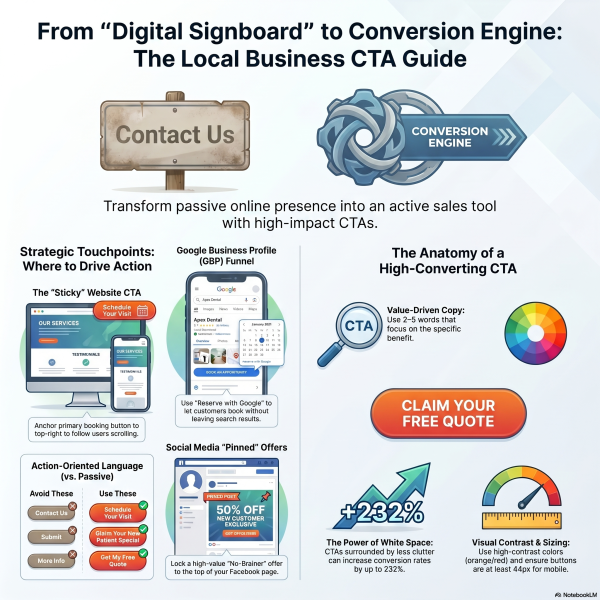
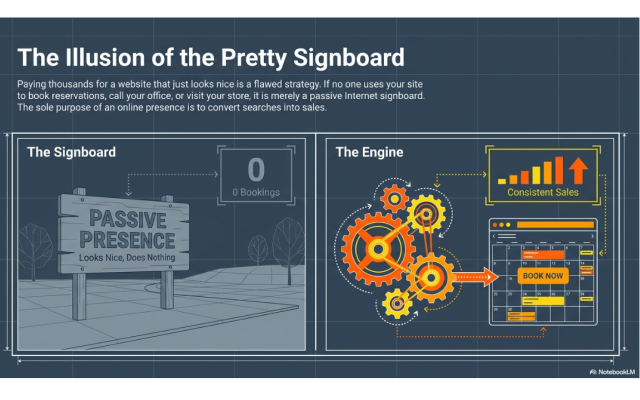
Many local business owners invest thousands of dollars in high-end web design, only to find themselves with a digital asset that looks beautiful but stays silent. These are "Internet signboards"—they exist, they look nice to passersby, but they fail to drive phone calls, store visits, or appointments.
As a webmaster, I see this daily: the gap between a "pretty" site and a "marketing website." A marketing website serves a single, clinical purpose: to convert searches into sales. The value of your digital presence is not measured in aesthetics; it is measured in high-intent actions. To bridge the gap, you must stop treating your website as a static brochure and start treating it as a conversion engine.
The following five strategies shift your focus from passive aesthetics to proactive growth by leveraging strategic Calls to Action (CTAs).
Your Website Isn’t Your Homepage—Your Google Business Profile Is
In a localized, highly competitive market—like the dental industry in Denver—your Google Business Profile (GBP) is often the actual homepage for your prospective patients. Many users will make a high-intent decision to book right from the search results without ever visiting your actual website. To capture these leads, you must treat your GBP as a self-contained conversion funnel.
Optimize the "Appointments" Link: This is the most critical CTA on your profile. Do not link this to your generic homepage. Link it directly to your scheduling calendar or a high-converting landing page to bypass unnecessary clicks.
Utilize "Reserve with Google" Integration: If you use scheduling software like NexHealth, LocalMed, or Zocdoc, ensure you are using this partner integration. It places a prominent blue "Book Online" button on your profile, allowing bookings without the user ever leaving the Google interface.
Deploy the "Products" Carousel for Services: Creatively use the "Products" feature to visually showcase high-margin treatments like Invisalign or dental implants. Each "product" allows for a photo, a description, and a visual CTA like "Learn More."
Analytical Reflection: Not every patient is ready for a "hard sell" immediately. Turning on the GBP "Message" (Chat) feature provides a low-friction entry point for hesitant patients. It removes the social pressure of a live phone conversation, allowing a casual inquiry about insurance or availability to be converted into a booked appointment by your front desk.
The Psychology of the "No-Brainer" Offer
Standard "Contact Us" buttons fail because they offer no immediate value proposition. In a crowded market, consumers face a significant psychological hurdle when "switching" providers. To overcome this, you need a "lead magnet" or a "No-Brainer" offer that makes the decision to switch risk-free.
For a dental practice, this might be a "$99 New Patient Exam, X-Rays, & Cleaning." This offer must be placed "above the fold"—the area visible immediately upon loading without the user needing to scroll.
"There’s really no good reason to have a business website other than to convert searches into sales."
However, an offer is only as strong as the trust behind it. In healthcare, trust is your actual currency. You must bolster your offer with "Social Proof" elements found in the source: embed a live widget of your 5-star Google Reviews and showcase a visual portfolio of before/after restorative work. This creates the necessary credibility to make the "No-Brainer" offer truly irresistible.
White Space and Contrast Are Non-Negotiable
Effective conversion relies on technical precision in visual design. If your CTA button blends into your brand’s color palette, it will be ignored. To stop the scroll, you must use strategic visual design requirements:
Use High-Contrast Colors: Choose vibrant colors like orange, red, or yellow that pop against your background.
Optimize for the Mobile Patient: More than 50% of your local traffic arrives via smartphone. Your buttons must be large enough—ideally 44px to 88px—to be easily tapped without accidental clicks.
Leverage White Space: Surround your CTA with empty space to let it "breathe." This forces the eye to gravitate toward the intended action by removing visual clutter.
Ditch Stock Photography: Replace models with impossibly white teeth with real, high-quality photos of your Denver office and staff. Real photos build instant trust, whereas stock photos create a "salesy" friction that kills conversions.
"CTAs surrounded by less clutter and more white space can increase conversion rates by 232%."
Stop Making Them Wait: The End of the Contact Form
The traditional contact form is where leads go to die. If a patient is browsing your site at 9:00 PM with an after-hours toothache, they don't want to fill out a form and wait for a callback the next morning. They want an immediate solution.
The solution is Bidirectional Syncing through tools like LocalMed or NexHealth. These platforms don't just send an email request; they read your live calendar and write the appointment directly into your system. This allows the "sales machine" to work without your staff lifting a finger.
To maximize this, implement a "Sticky" CTA: a "Book Online Now" button anchored to the top right of your menu that follows the user as they scroll. This ensures that no matter where they are on the page, the map to the next step is always visible.
Turning Social Media into a Direct Conversion Funnel
Social media should be treated as a direct extension of your sales funnel, not just a place for "likes." The goal is to remove every possible point of friction between a social feed and your booking page.
The Golden Rule of Action Buttons: Set your primary Facebook "Action Button" to "Book Now" or "Learn More." Never link this to your generic homepage; link it directly to your scheduling tool or your offer's landing page.
Pinned Posts as Digital Billboards: Create a high-quality post featuring your "No-Brainer" offer and pin it to the top of your feed. Ensure the CTA and link are in the first two sentences so they aren't hidden by the "See More" tag.
Link Stickers in Stories: Use the vertical Story format to share office tours or staff spotlights. Use the Link Sticker feature to allow patients to tap and go straight to your conversion page.
Attach Real Buttons via Boosted Posts: While organic links are useful, using a paid "Boost" allows you to attach a formal, clickable CTA button (like "Get Offer") to the post. This professional interface generates significantly higher click-through rates than standard text links.
From Passive to Proactive
The shift from an "Internet signboard" to a "marketing website" requires a fundamental change in mindset. You must stop asking your website to look pretty and start asking it to work. Every element of your digital presence—from the contrast of your buttons to the bidirectional syncing of your calendar—must proactively guide the user toward a single, clear action.
“A strong call to action can stop people and make them pay attention, ultimately leading to a sale.”
Is your current website working for you, or is it just sitting there looking pretty while your competitors book your next client?
Ken Heistand is an author, webmaster and creator of web based solutions - helping local business owners learn to harness the power of cell phone searches by turning them into sales.
About this article:
This article is a primer for local businesses to transform passive websites into high-converting marketing engines by implementing effective calls to action (CTAs). It emphasizes that a successful online presence must move beyond mere aesthetics to provide clear, immediate guidance for visitors through action-oriented language and strategic design. The sources outline specific tactics for optimizing digital touchpoints, including a company's main website, its Google Business Profile, and various social media channels. By utilizing direct scheduling tools, creating high-contrast buttons, and offering time-sensitive incentives, business owners can significantly reduce friction in the customer journey. Ultimately, the material highlights that persistent testing and visual prominence are essential for converting casual searchers into loyal, paying clients.
They search, you show up first, SALE!!


KB Local Web
Explore our sleek website options for local businesses.
Contact
316-202-9015
© 2026. All rights reserved.