We help local businesses make more money - it's that simple!
Crafting Your Unique Selling Proposition
Your Greatest Competitive Advantage In A Few Words
Ken Heistand
4/29/20265 min read
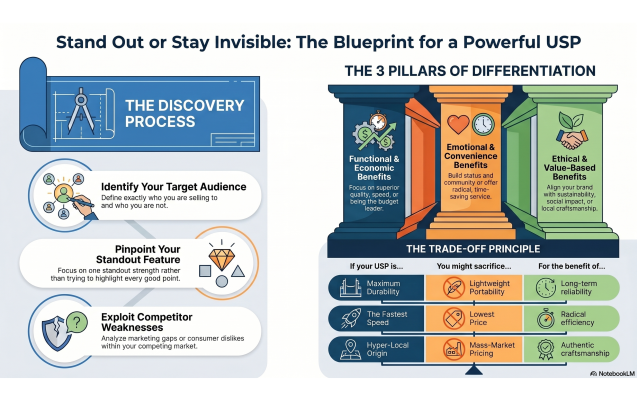
Why Being "Good" Is the Fastest Way to Get Overlooked
In the modern marketplace, "good" is no longer a differentiator; it is the baseline for entry. Many entrepreneurs fall into a catastrophic trap, believing that a high-value product coupled with a fair price will naturally garner attention. In reality, invisibility is rarely a product of poor quality. It is a strategic failure of identity. Without a clear signal to cut through the noise, potential customers default to the path of least resistance: the largest incumbent or the lowest price.
The antidote to this strategic invisibility is the Unique Selling Proposition (USP). Far from a mere marketing slogan, the USP is the fundamental feature of your enterprise—the singular reason your customers choose to do business with you. It is the primary driver of exceptional ROI, moving your brand beyond the "commodity" category and into the realm of the essential.
The Specificity Paradox: Why FedEx and Domino’s Win
There is a common, though misguided, instinct to keep a brand promise broad to avoid alienating potential segments. However, market masters understand the Specificity Paradox: the more hyper-specific your promise, the deeper the trust you cultivate. Consider the legendary architectures of FedEx and Domino’s. FedEx did not simply promise "reliable shipping"; they promised "absolutely positively overnight." Domino’s did not merely offer "quick pizza"; they guaranteed "fresh, hot pizza to your door in 30 minutes or less, or it's free."
In both cases, the specificity is a "measure of trust." By defining a measurable, binary standard for success, these brands reassure the consumer of their operational confidence. As the source material highlights:
"A specific USP like that can reassure your consumers about your ability to deliver on your promise and enhance your brand reputation."
Why Your Small Business Shouldn’t Race to the Bottom
Like my mafia mentor always said " never be the low price leader".
For many small businesses, the impulse to compete on price is a siren song that leads to margin erosion and eventual obsolescence. Competing on "lowest price" is a battle of attrition that smaller players almost always lose against big-box giants with massive economies of scale.
Instead of a race to the bottom, the modern entrepreneur must weaponize their innate advantages: agility, speed, and intimacy. While a multi-national corporation is hampered by bureaucratic inertia, a smaller firm can pivot its entire service model in a afternoon. Differentiation is not found in the price tag, but within what we might call:
The Small Business Arsenal
Adaptability: The capacity to pivot instantly based on emerging market shifts.
Speed: Shorter lead times and faster response cycles than corporate hierarchies.
Service: High-touch, human-to-human interaction that bots cannot replicate.
Personalization: The ability to tailor a solution to the individual rather than the mass-market average.
The Power of the "Trade-Off": Defining What You Are Not
A potent USP requires the courage to make a strategic trade-off. This is where specificity meets sacrifice. If you attempt to be recognized for everything, you effectively become known for nothing. A strong brand identity is as much about what you exclude as what you include.
This strategic exclusion makes a brand more believable. For instance, if you position yourself as the premium, "built-to-last-a-lifetime" option, your market understands—and accepts—that you will not be the cheapest. By explicitly choosing what you are not, you reinforce the authenticity of your primary claim. Specificity requires the sacrifice of the "generalist" identity to own a "specialist" territory.
Moving Beyond "Quality": The Five Pillars of Customer Benefit
To move beyond the hollow claim of "quality," a USP must be anchored in a specific category of benefit. These five pillars provide the framework for your strategic positioning:
Functional & Performance: Focusing on tangible results and durability, such as gear that is "built to last a lifetime" or specialized tools for niche tasks.
Economic & Value: Addressing the total cost of ownership or transparent pricing models that eliminate the "hidden fees" common among competitors.
Emotional & Psychological: Tapping into exclusivity, status, or the peace of mind that comes from knowing a product is engineered for maximum safety.
Convenience & Service: Differentiating through radical availability (24/7 support) or a "concierge" experience that brings the solution directly to the client.
Ethical & Value-Based: Aligning with the customer’s worldview through sustainability, carbon-neutral shipping, or "buy-one-give-one" social impact models.
To see these pillars in action, we must look at how a boutique retailer can dismantle a national giant’s scale through the lens of hyper-localized expertise.
The "Local Legend" Strategy: Outsmarting the Big-Box Giants
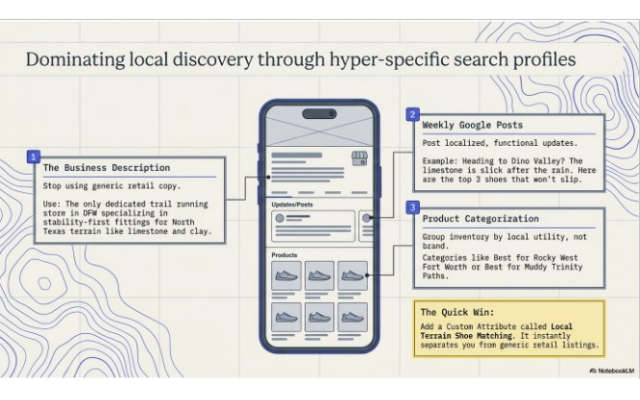
Consider a specialized shoe store in the Dallas-Fort Worth (DFW) market. While a national chain sells "trail shoes" as a generic commodity, a "Local Legend" can offer "Terrain-Matched Fitting."
The DFW terrain is a unique challenge, featuring the notorious "North Texas Gumbo" (a sticky, relentless clay) and loose, marble-like limestone. An expert retailer knows that a shoe that works in the soft dirt of the Pacific Northwest will fail on the rocky, sun-baked paths of Cedar Ridge Preserve, Sansom Park, or the Dino Valley trails. By offering gait analysis on a "Limestone Stress Test" track in-store, the local retailer transforms from a clerk into a consultant.
Furthermore, the local expert addresses the "Heat Factor"—a primary pain point for Texas runners. A USP focused on specific breathability and drainage for humid DFW mornings or creek crossings at Isle du Bois creates a secondary layer of authority that national "all-weather" marketing misses.
"By being the 'DFW Terrain Expert,' you make their [big-box retailers'] massive inventory look 'generic' and 'uninformed.'"
From General Retailer to "Basecamp"
The ultimate goal of a USP is to shift your identity from a generic provider to a "Basecamp"—a specialized hub providing the tools, expertise, and community your customers need to navigate their specific "terrain," whether literal or metaphorical.
In a world of infinite, average options, specificity is the only currency that matters. As you refine your market position, look beyond the product and toward the transformation you offer. If your business disappeared tomorrow, would your customers merely miss a product, or would they miss a solution only you—with your unique blend of trade-offs and expertise—could provide?
Ken Heistand is an author, webmaster and creator of web based solutions - helping local business owners learn to harness the power of cell phone searches by turning them into sales.
About this article:
A Unique Selling Proposition (USP) serves as the essential feature that distinguishes a business from its rivals and provides customers with a definitive reason to choose their brand. Developing an effective USP requires a deep understanding of the target audience, an analysis of competitor weaknesses, and the identification of specific functional or emotional benefits. Rather than competing solely on price, companies should focus on specialized areas like superior service, ethical sourcing, or technical performance to build a lasting reputation. This article illustrates these principles through a detailed case study of the Dallas shoe market, showing how a retailer can dominate a niche by addressing local challenges like specific terrain and climate. Ultimately, a successful strategy involves consistently communicating this distinctive value across all digital and physical marketing channels.
They search, you show up first, SALE!!


KB Local Web
Explore our sleek website options for local businesses.
Contact
316-202-9015
© 2026. All rights reserved.