We help local businesses make more money - it's that simple!
Make Your Business A Problem-Solving Machine
Stop Selling Products and Services: 5 Surprising Shifts To Dominate Your Local Market
Ken Heistand
4/11/20265 min read
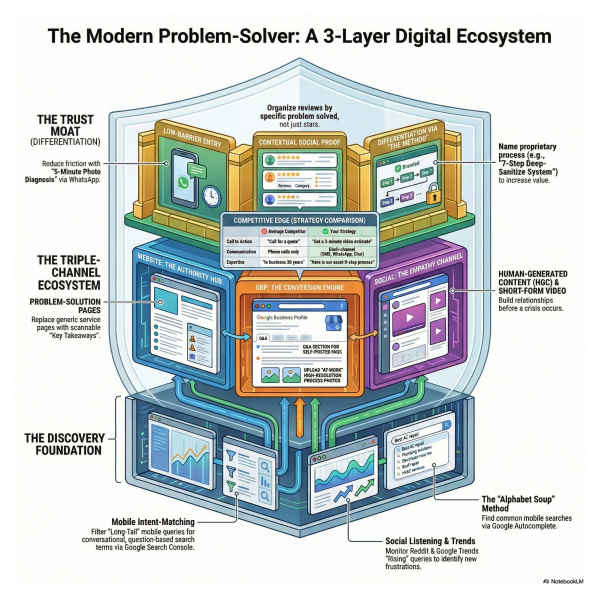
Traditional SEO has been mired in the "Keyword Trap" for far too long. Businesses pour capital into ranking for broad terms like "Plumber" or "Electrician," only to suffer from high bounce rates and dismal conversion. This is a fundamental misunderstanding of user psychology: customers aren't looking for a business; they are looking for a surgical solution to a specific friction point that has derailed their day.
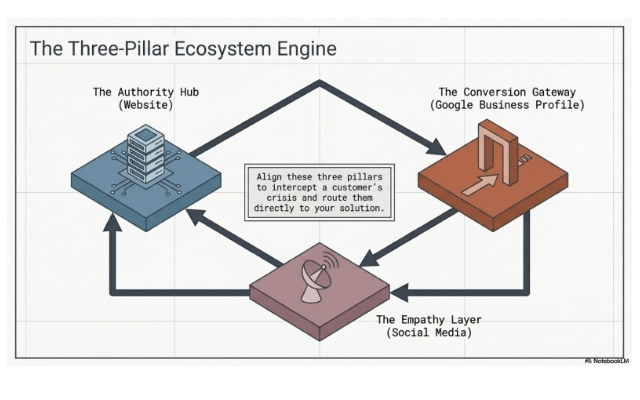
The core strategic shift required for modern growth is moving from keyword-stuffing to intent-matching. This involves aligning your digital footprint—professional website, Google Business Profile (GBP), and social media—into a single, helpful ecosystem designed to resolve specific customer frustrations. To win you must stop selling a service and start engineering a solution.
Kill the "Services" Page and Solve the "Micro-Intent"
A generic, multi-paragraph "Services" page is where potential leads go to die. It signals a generalist mindset, and in a competitive market, generalists are treated as commodities. To capture high-intent traffic, you must pivot to "Problem-Solution" pages that target micro-intent.
Consider a homeowner at 3 AM. They aren't searching for "General Plumbing Services"; they are searching for "how to fix a vibrating pipe at 3 AM." By creating a dedicated page for that specific, urgent symptom, you meet the customer at their exact moment of crisis.
The Authority of Deep-Dive Resources Broad summaries signal low-value generalism. In contrast, deep-dive resources signal high-value specialization, which inherently justifies premium pricing. By utilizing a "Pillar & Cluster" model—linking one "Ultimate Guide" to highly specific sub-topics—you build a "Trust Moat." Furthermore, this structure is essential for future-proofing your brand against Google’s SGE (Search Generative Experience). AI-enabled search pulls snippets from scannable, expert content; if your site doesn't offer deep, structured answers, you won't exist in the AI-driven results of tomorrow. Finally, these pages must include "Proof of Fit"—embedding success stories and video testimonials directly alongside the problem they solve to bridge the gap between information and action.
Your Google Business Profile is a Mini-Homepage
Most businesses treat their Google Business Profile (GBP) as a static listing. This is a missed opportunity. Your GBP is a high-velocity conversion engine and often the only "homepage" a mobile user will ever see.
A primary strategy for maximizing this tool is aggressive Q&A management. Do not wait for customers to ask questions; plant your own FAQs to dismantle barriers to entry immediately.
Question: "Can you repair solar-powered water heaters?" Answer: "Yes! We specialize in brand X and Y solar units. We usually have parts in stock for same-day repair."
To dominate local search, you must also master "Attributes." For instance, toggling the "Emergency 24/7 support" attribute is the difference between appearing in "near me" searches during off-hours or being invisible. Couple this with "Visual Proof"—high-resolution photos of your team "at work" rather than just static "after" shots. Seeing the process in action builds far more psychological trust than a polished result ever could.
Mobile Search is a Different Language
Mobile search behavior is conversational, local, and immediate. It is a completely different language than desktop search. To decode it, you must use the "Device Filter" in Google Search Console to isolate mobile-specific queries and uncover the long-tail questions your customers are actually asking.
You can also use the "Alphabet Soup" method: on a mobile device, type your industry followed by "how to..." and then cycle through the alphabet (a, b, c). Google’s autocomplete will reveal the exact phrases mobile users are typing in real-time.
Build a "Trust Moat" by Naming Your Process
In a saturated market, if you "clean houses" or "fix HVAC units," you are a commodity. Commodities compete on price. To escape the race to the bottom, you must differentiate via "The Method."
Stop saying "We've been in business 20 years"—the average competitor says that. Instead, name your proprietary process. Telling a client you use the "7-Step Deep-Sanitize System" creates a higher perceived value and a specialized solution that cannot be easily compared to the guy down the street.
To further reduce friction for high-stress mobile users, implement an "Immediate Win." Offer a "5-Minute Photo Diagnosis" via SMS or a "Transparent Pricing Guide." When you provide clarity where others provide "call for a quote" ambiguity, you build a trust moat that your competitors cannot cross.
Be the Guide, Not the Hero
The most common marketing failure is positioning the business as the hero. In your customer's story, they are the hero. Your business must be the "Guide" who provides the empathy and authority they need to succeed.
To execute this, use the Empathy + Authority Formula:
[Empathy]: "I know how frustrating it is when your heater dies in the middle of the night..." [Authority]: "...and we’ve helped 500 people in [City] fix exactly that problem."
This perspective should dictate your social proof. Generic 5-star reviews ("Great service!") are the bare minimum. You need "Problem-Matched Reviews." If a customer has a broken heater, a review specifically detailing how you fixed a heater at 10 PM is 10 times more persuasive than a hundred generic ratings.
The Speed to Lead Advantage
Today's successful local business owner understands that the first person to reduce friction on mobile wins the contract. This is the "Speed to Lead" advantage. If you are driving traffic to your site but aren't answering the phone or responding to texts instantly, you have a "Leaky Bucket" problem. You are wasting marketing spend on traffic that simply flows to the next search result.
If you can’t answer the phone, use an automated "First Touch"—a text message saying, "Hi! We're helping another customer, but check out this 'Quick Fix Guide' while you wait." This small bridge between stress and solution prevents the customer from clicking on your competitor.
The businesses that will thrive in the next era are those that stop acting like service providers and start acting like friction-reducers. Which friction point is currently costing you the most in missed mobile conversions?
Ken Heistand is an author, webmaster and creator of web based solutions - helping local business owners learn to harness the power of cell phone searches by turning them into sales.
About this article:
Modern digital marketing focuses on intent-matching, where businesses prioritize solving specific customer problems rather than just selling services. To succeed, companies must integrate their websites, Google Business Profiles, and social media into a cohesive ecosystem that establishes authority and builds trust. Websites serve as information hubs for deep-dive solutions, while local listings and social channels act as engines for conversion and emotional engagement. Effective strategies involve analyzing mobile search data and "social listening" to identify the exact language and frustrations of the target audience. By offering immediate value, transparent pricing, and specialized processes, a business can differentiate itself as a guide in the customer’s journey. Ultimately, the goal is to transform from a generic provider into a trusted problem-solver through high-speed communication and contextual social proof.
They search, you show up first, SALE!!


KB Local Web
Explore our sleek website options for local businesses.
Contact
316-202-9015
© 2026. All rights reserved.