We help local businesses make more money - it's that simple!
Marketing Angles Turn Searches Into Sales
Stop Selling Products: The Psychological "Hooks" That Turn Browsers into Buyers
Ken Heistand
3/16/20264 min read
The Mystery of the Unsold Inventory
Many local business owners face a common frustration: shelves filled with high-quality inventory that simply isn't moving despite its obvious value. You know your products are excellent, yet potential customers pass them by without a second glance. The missing link is rarely the product itself; rather, it is the lack of a "Marketing Angle"—the strategic psychological context that transforms a generic item into a unique, compelling solution. By learning to "whisper about transformation" rather than shouting about features, you can align your offerings with the specific desires already living in your customers' heads.
Takeaway 1: You Aren't Selling a Drill, You're Selling a Hole
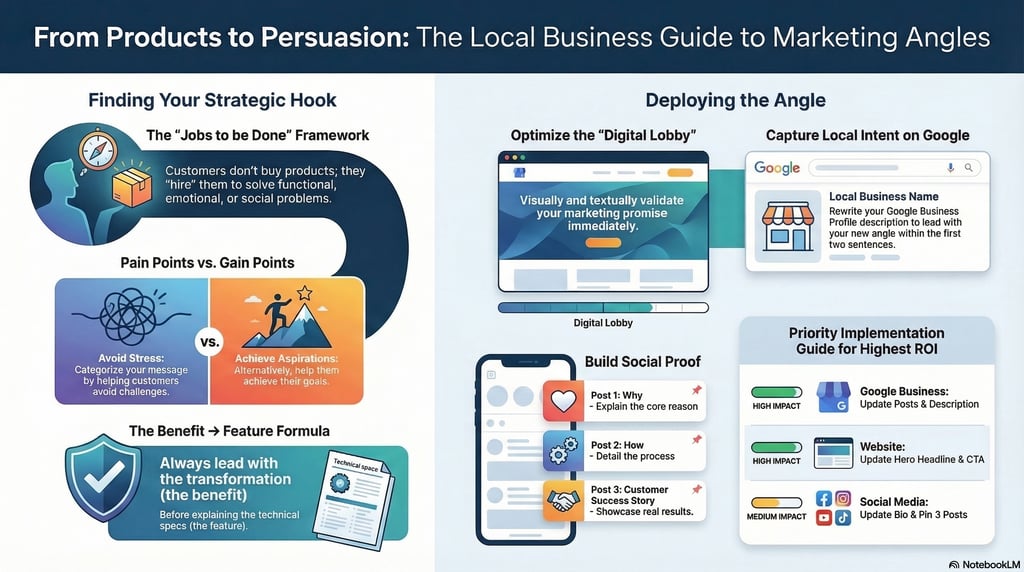
To move products effectively, a growth-minded business must adopt the "Jobs to be Done" framework. This perspective suggests that customers do not merely buy a product; they "hire" it to perform a specific task. For example, a customer doesn’t want a drill for the sake of owning a power tool; they hire the drill to create a hole in the wall so a family photo can be hung.
Marketing angles can be categorized into three sub-drivers based on this framework:
The Functional Angle: Focuses on efficiency, speed, or solving a literal problem, such as "Fix your leaky faucet in five minutes."
The Emotional Angle: Focuses on the internal state of the user, such as "The peace of mind that comes with a secure home."
The Social Angle: Focuses on how the user wants to be perceived by others, such as "Be the house everyone wants to visit for Sunday dinner."
"The trick isn't to shout about the product itself, but to whisper about the transformation it provides."
Takeaway 2: The "Benefit → Feature" Golden Rule
A common marketing pitfall is leading with technical specifications. Features describe what a product is, but benefits describe the outcome for the customer. In a crowded digital space, leading with outcomes is the only way to capture the immediate attention of specific segments like "The Busy Parent" looking for ease or "The DIY Hobbyist" looking for professional results.
Consider the difference in messaging for an ergonomic chair:
Bad: "We sell ergonomic chairs."
Good: "Work 8 hours without the backache (Benefit) thanks to our lumbar-sync technology (Feature)."
By shifting the perspective to the benefit, you immediately answer the customer's unspoken question: "What is in it for me?"
Takeaway 3: Choosing Your Side—Pain, Gain, and Context
Effective messaging generally falls into two psychological camps: avoiding a negative or achieving a positive.
Pain Point Messaging: Focuses on avoiding a negative outcome or reducing stress. For instance: "Tired of wasting money on lightbulbs that flicker?"
Gain Point Messaging: Focuses on achieving an aspiration or luxury, such as: "Transform your living room into a high-end cinema."
However, a sophisticated Marketing Strategist also utilizes the Contextual Angle. This accounts for when a customer buys. You can rotate your messaging based on Seasonal/Event-based needs (e.g., solving a "Back to School" problem) or Micro-Moments (targeting the "I-need-to-fix-this-now" urgency versus the "I’m-browsing-for-inspiration" phase).
Takeaway 4: The "Digital Lobby" and the Power of Alignment
Once you have defined your angle, you must deploy it across your "Digital Lobby"—your website, Google Business Profile (GBP), and social media. Consistency ensures that a customer experiences the same "vibe" from their first search to their in-store visit.
To capture "local intent," prioritize your updates based on impact:
Google Business Profile (High Priority): This is often the first point of contact. Use the 750-character "From the Business" description to lead with your new angle in the first two sentences. Use the Q&A section proactively by "asking" and answering a question that highlights your solution (e.g., "Do you have options for people with very little time?").
Website (High Priority): Your Hero Section—the main headline and image—must validate the promise of your ads immediately. If your angle is "Time-Saving," the image should feature a relaxed, efficient person rather than a cluttered product shot.
Social Media (Medium Priority): This builds brand trust through storytelling. Align your profile bio with your angle and create three pinned posts that explain the "Why," the "How," and a "Customer Success Story" related to that specific angle.
Peer Tip: Don’t try to overhaul everything at once. Start by updating your highest-traffic page—usually the Homepage or a top-selling product page—to avoid overwhelm while maximizing conversion.
Takeaway 5: Stop Guessing and Start Listening
The most effective headlines are rarely the result of creative guesswork; they are found in the "exact words" your customers use. To find an "Expert Angle" or an "Inverse Angle" (e.g., if competitors focus on "fancy," you focus on "durable"), look at your best reviews and listen to in-store questions.
To turn these insights into a strategy, create a Messaging Matrix using this three-step exercise:
Pick one product from your inventory that feels "sleepy."
Identify three distinct personas (e.g., The Busy Parent, The DIY Hobbyist, The Budget Hunter).
Write one headline for each that addresses their specific "Job to be Done" using their own language.
Conclusion: From Search to Sale
Successful marketing is the intersection between what a product does and the specific problem residing in your customer's head. It requires a fundamental shift from selling items to selling transformations.
When you look at your inventory today, ask yourself: Which "Job" is your most popular product actually being hired to do? A single shift in your marketing angle can wake up even the quietest product line and turn simple searches into guaranteed sales.
Ken Heistand is an author, webmaster and creator of web based solutions - helping local business owners learn to harness the power of cell phone searches by turning them into sales.
About this article: it's important to realize that our customers have buying habits and preferences that they do not totally understand. They act on impulse, and most times this manifests as a cell phone search to learn more about what they want and where they can get it.
It's like a blooming flower though - it can be gone as fast as it came to them, so catching your customer right when they are focused on solving their problem is the key to "sales on demand".
They search, you show up first, SALE!!


KB Local Web
Explore our sleek website options for local businesses.
Contact
316-202-9015
© 2026. All rights reserved.