We help local businesses make more money - it's that simple!
Outsmart Your Local Competition Without Spending a Dime
Learn The Secret Sauce of "Social Stalking"
Ken Heistand
4/27/20265 min read
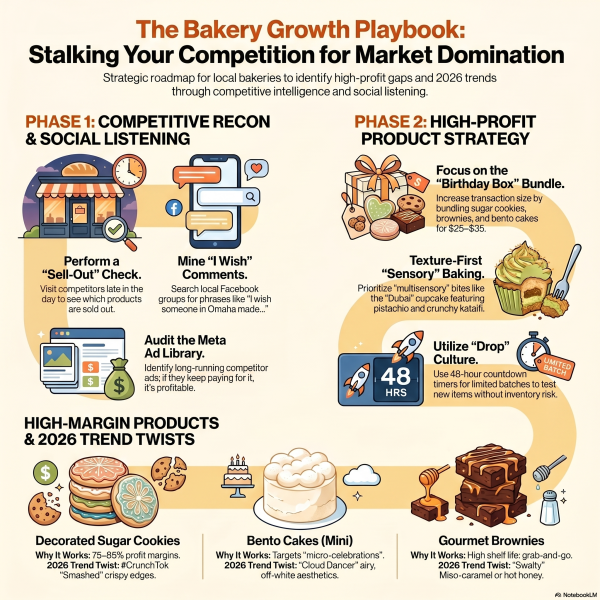
The "Recon" Revolution
For many small business owners, competition feels like a looming threat to the bottom line. But as a strategic growth consultant, I view your competitors differently: they are your most valuable, unpaid R&D department. "Social stalking" isn’t about being malicious—it is a sophisticated form of Market Gap Analysis. By systematically observing your neighbors, you can identify the "sweet spot" between high-margin efficiency and the products your community is already starving for.
Take, for example, the bakery landscape in Omaha, Nebraska. In a market saturated with standard birthday cake shops, the winners aren't the ones guessing what people want; they are the ones performing "recon" to find out exactly where the market is underserved. This approach transforms your business from a reactive shop into a proactive retail powerhouse.
Perform the "Sell-Out" Check
Spreadsheets and marketing flyers can lie, but inventory levels never do. To perform an authentic audit of Consumer Sentiment, you need to engage in the "Sell-Out" check. Visit your local competitors—such as Sweet Magnolias or Cinnaholic—late in the afternoon, ideally after 4:00 PM.
This is the most honest data you will ever find. Items that are gone or nearly empty are the "hero" products—the high-velocity winners driving their revenue. Conversely, shelves that are still fully stocked represent Inventory Optimization failures. By observing this "physical evidence," you can stop wasting your own labor on underperformers and pivot your production toward proven local cravings.
Mine the "Negative Space" in Reviews
Online reviews are often viewed as a customer service hurdle, but for a strategist, they are a blueprint for your next profitable product launch. Use Yelp or Google to search for local competitors and immediately filter by "Lowest Rated." Do not look for one-off rants; look for recurring grievances.
If you see repeated complaints about a lack of gluten-free options or that the current offerings are "sugar-bombs" with no flavor depth, you have found a market opening.
"Pay attention to the negative space: 'I love [Competitor A], but I wish they were open on Sundays,' or 'I wish someone in Omaha made a decent [specific item].'"
Solving a competitor’s failure is the fastest route to ROI. When you fill a gap that the "market is screaming for," you aren’t just selling a product; you are providing a long-awaited solution.
While review mining shows you today's grievances, staying ahead of the competition requires looking at the sensory shifts of tomorrow.
Texture is the New Taste
The market is currently moving away from simple "sugar-bombs" toward sophisticated, multi-sensory experiences. The new consumer demand is for "multisensory bites" that combine Crispy, Flaky, Gooey, and Chewy textures. We are also seeing a massive rise in Functional Niches, specifically high-protein or gluten-free "guilt-free" treats that capture customers who typically skip dessert.
To maintain a competitive edge, focus on these high-margin, trend-aligned iterations:
The "Dubai Effect" Cupcake: Incorporate Pistachio and Kataifi (crunchy phyllo) for a premium-priced, high-texture bestseller.
Modern Butter Brickle: Use Omaha’s birthplace-nostalgia to create a premium, locally-branded cake or cookie that chains cannot replicate.
#CrunchTok Smashed Cookies: Create extra-crispy edges on traditional sugar cookies to satisfy the current aesthetic trend.
"Swalty" & Global Fusion: Integrate miso-caramel, hot honey, or botanical notes like Matcha, Ube, and Cardamom to appeal to a more mature palate.
Master the Art of "Social Listening"
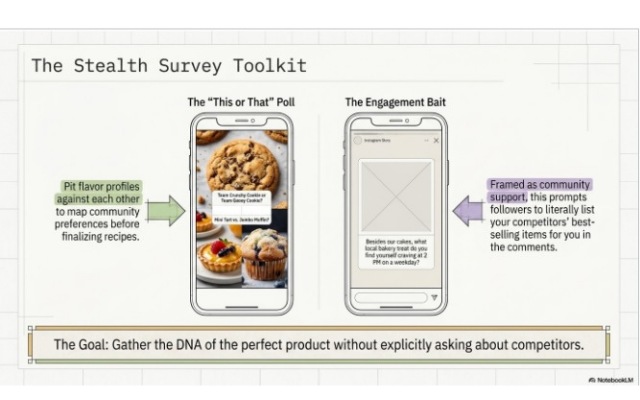
One of the biggest mistakes business owners make is being a "social asker." When you ask, "What do you want?" customers rarely have the answer. Instead, you must become a Social Listener.
Dive into local Facebook groups like Omaha Foodies or Omaha Moms and use these tactical filters:
Keyword History: Search group archives for "best bakery" or "cupcakes" to see which competitors have the most organic brand equity.
The "Tag" Method: Observe which businesses are tagged for high-stakes events like birthdays. If a competitor is tagged for their "aesthetic" but commenters mention the flavor is "cardboard," your marketing should lead with "flavor-first" messaging to win that business.
Unfiltered Sentiment: Look for the "I wish" comments in these threads. They reveal the "DNA" of the perfect product that your competition is currently ignoring.
Use the Meta Ad Library as a Profitability Filter
Stop guessing which products to put your marketing spend behind. The Meta Ad Library is a free tool that allows you to see exactly what your competitors are paying to promote.
Search the Meta Ad Library for your top three local competitors.
Identify which specific products they are currently featuring in paid ads.
Analyze the Duration: This is the most critical metric. If an ad for a "Lemon Lavender Tart" has been active for three months, it is a proven winner. A business will not continue to burn capital on an ad that isn't driving a return.
Embrace "Drop Culture" and Mini-Formats
In the "Ozempic-era," consumers are shifting toward high-quality, small-portion indulgence. "Small is the New Big." This shift makes Mini-Formats like Bento Cakes or bite-sized "Discovery Boxes" essential for testing new items with minimal risk.
To maximize your transaction size, synthesize these trends into a "Birthday Box" bundle. By offering a 25–35 pack containing 4 sugar cookies, 2 brownies, and a bento cake, you increase the average order value while minimizing labor.
The Flavor Drop: Use 48-hour "pre-order only" windows for new items like the Dubai Cupcake. This creates FOMO and allows you to test viability without daily inventory waste.
Texture-First Imagery: Your digital storefront must adapt to 2026 mobile trends. Use close-up, short-form video that highlights the "ooze" or the "crunch." People eat with their eyes—don't just show the product; show the texture.
Dominate with Hyper-Local SEO
A digital marketing specialist knows that being "better" isn't enough; you must be "found." To capture the Omaha market, you must optimize for "Near Me" search intent.
Google Business Profile (GBP) Integration: Update your "In-Stock" items on your GBP frequently. Google prioritizes businesses that provide real-time product data.
Local Keyword Tagging: Use specific phrases like "Best sourdough in West Omaha" or "Where to find gluten-free treats in the Old Market" in your blog posts and product descriptions. This ensures you are the first solution customers see when they search for local cravings.
From Static Menu to Community Hub
By moving from a static menu to a dynamic, data-driven strategy, you stop being just another shop and start becoming a community hub. When you launch a "Community Requests" page—stating, "We heard you wanted a high-protein birthday treat, so we perfected our own Omaha version"—you turn customers into co-creators.
This builds a level of local loyalty that national chains and unobservant competitors can never replicate. You are no longer guessing; you are responding to the market's specific demands with surgical precision.
Are you building the business you want, or the one the market is screaming for?
The most successful businesses don't just sell products; they provide the solutions their community is already searching for.
Ken Heistand is an author, webmaster and creator of web based solutions - helping local business owners learn to harness the power of cell phone searches by turning them into sales.
About this article:
This article outlines a strategic blueprint for small businesses, using Omaha-based bakeries as an example, to achieve market dominance by conducting competitive intelligence and leveraging social media. It emphasizes "stalking" local rivals to identify product gaps and high-margin trends, such as textured sweets and "mini" formats, for the 2026 market. The text provides actionable tactics for using Facebook and Meta tools to monitor competitor performance and gather unfiltered consumer feedback. Furthermore, it details how to convert these insights into sales through digital storefront optimization, limited-edition "drops," and hyper-local SEO strategies. Ultimately, the guide teaches entrepreneurs how to outmaneuver established brands by being more responsive to community cravings and data-driven in their product development. How can you use this technique in your business?
They search, you show up first, SALE!!


KB Local Web
Explore our sleek website options for local businesses.
Contact
316-202-9015
© 2026. All rights reserved.