We help local businesses make more money - it's that simple!
The Great American Business Tragedy
Your Business is Run by a Lunatic (and How to Fix It)
Ken Heistand
5/19/20266 min read
Every year, a million people in the United States embark on the dream of business ownership with absolute certainty. They believe they are about to change their fortunes, gain independence, and finally "get rid of the boss."
The reality is a bloodbath.
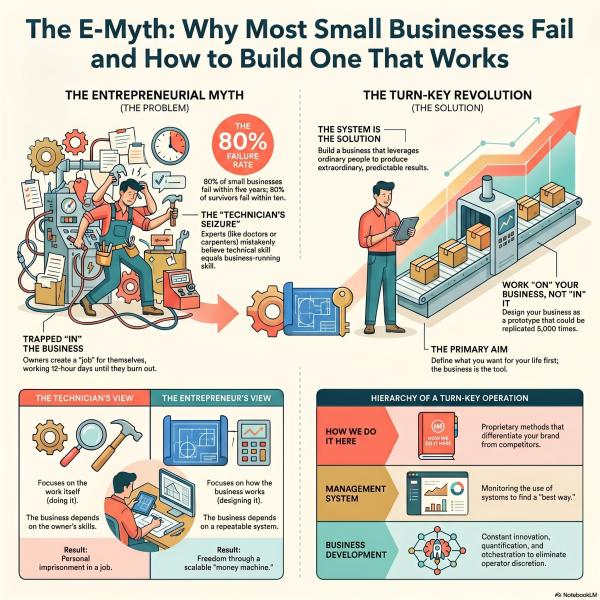
According to the IRS, there are 18.1 million businesses in this country. Of those, 18 million are small. They are the backbone of the economy, yet they are also the site of an extraordinary tragedy. Within five years, 800,000 of those annual startups will fail. For the survivors, the news is worse: 80% of those will fail in the next five years. If the first five years don’t kill you, the second five absolutely will.
The problem in American business isn’t the economy, interest rates, or a lack of capital. The problem is the person who owns the business. If most owners truly understood the carnage they were signing up for, they wouldn’t start a business—they’d put their money in a CD and keep the job they already have. Instead, they go to work for a lunatic: themselves. They trade a boss they hated for a disorganized, demanding tyrant who forces them to work twelve hours a day, seven days a week, until they run out of steam and the dream collapses into a disaster.
You Aren’t the Entrepreneur You Think You Are
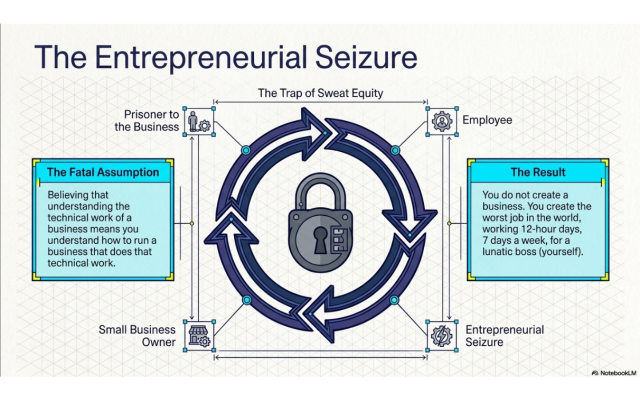
The "Entrepreneurial Myth" (E-Myth) is the foundation of every small business failure. It is the fatal assumption that because you understand the technical work of a business, you understand how to run a business that does that technical work.
Most businesses are not started by entrepreneurs; they are started by technicians suffering from an "entrepreneurial seizure." The carpenter becomes a contractor; the auto mechanic opens a shop; the poodle clipper starts a grooming salon. They think, "Why am I doing this for this guy? I could be doing this for me."
They are dead wrong. Knowing how to do the work is 180 degrees removed from knowing how to build a business that works.
"Knowing how to do the work in a business has nothing to do with creating a business that works... and it is the fatal assumption behind the failure of almost every single business."
Because the technician starts for the wrong reason—to get rid of the boss—they simply create the worst job in the world. They find themselves "doing it, doing it, doing it, doing it" every single day. If they stop, the business stops. They haven't built a business; they’ve built a prison of sweat equity.
Stop Working In Your Business, Start Working On It
To escape the technician’s grind, you must stop being a "doer" and start being an inventor. Look at the blueprint laid by Tom Watson, the founder of IBM. Watson didn't just build a company; he built a $59 billion monument to order. To put that in perspective, a billion dollars is $1,000 a day for 3,000 years in small, unmarked bills.
Watson achieved this because he had three critical realizations before he even started:
The Finished Vision: He had a clear picture in his mind of what IBM would look like when it was "finally done."
The Missionaries: He envisioned an army of people in dark suits, white shirts, and black shoes—missionaries of discipline and integrity who would bring his vision to life.
No Size Distinction: He realized there is no difference between a big business and a small business. A big business is simply a small business that did the right things from the very beginning.
Watson didn’t go to work in IBM; he went to work on IBM to replicate the vision in his mind.
Takeaway: The entrepreneur is an inventor of a business that works, not a technician who works in a business.
The McDonald’s Miracle: The Business is the Product
The "Turnkey Revolution" began when Ray Kroc, a 52-year-old malted milk machine salesman, walked into a burger stand in San Bernardino. Kroc saw what the McDonald brothers didn’t: the hamburger wasn't the product. The business itself was the product.
Kroc’s true customer was the franchisee. He realized he was selling "Independence and Security." To deliver that, he had to create a "money machine" that worked predictably every single time. He sold the one thing every consumer craves above all else: CONTROL (C-O-N-T-R-O-L).
The System over the Individual: McDonald’s produces extraordinary results using ordinary people—minimum wage kids with a 300% annual turnover. They succeed because they don't depend on "extraordinary" people; they depend on an extraordinary system.
The Turnkey Model: At "Hamburger U," franchisees learn to run a machine, not to innovate. They are told never to change the system, because the system is the goose that lays the golden eggs.
"The system is the solution. Not people, not the product; the system is the solution."
The "5,000 Store" Mental Model
The secret to business freedom is to act as though you are going to replicate your business 5,000 times. This mindset forces you to build an "expert system" rather than relying on "expert people." If you have an expert system, you can leverage ordinary people to produce extraordinary results.
A true turnkey system requires four integrated levels:
How We Do It Here: A proprietary, standardized way of doing business that differentiates you.
Recruitment and Training: A system to teach ordinary people how to execute your proprietary methods.
Management System: A process to monitor the other systems and find a "better way" to give the customer a sense of control.
Business Development: The cycle of Innovation (finding a better way), Quantification (measuring the impact), and Orchestration (eliminating individual discretion or choice at the operating level to ensure it happens the right way every time).
The "Mary" Trap: Why Personalities Kill Scalability
Most small businesses are built around "Mary"—the indispensable employee who does everything. The owner thinks Mary is a blessing; in reality, Mary is a ticking time bomb. When Mary leaves, the business collapses because the "system" lived only in her head.
The absurdity of the "Mary" model is found in the typical job description: Wanted—person to do marketing, administration, answer phones, and take the laundry in and out for $4.25 an hour. Nobody answers that ad, so when Mary leaves, you have to hire seventeen people to replace her.
To fix this, you must build an organization chart based on functions, not personalities. You must define the boxes—Marketing, Operations, Finance—and create "position contracts" for each. The business must be a functional infrastructure where anyone can be trained to produce the required result.
The Primary Aim and Your New Life
Building a business that works is a disciplined seven-step process:
Primary Aim: What do you want for your life? (The business is a means to this end).
Strategic Objective: What will the business look like when finished? (Gross revenues, profits, etc.).
Organization Chart: Defining functional responsibilities over people.
Management System: The "how we manage" prototype.
People Development: An environment where ordinary people succeed.
Marketing Development: Understanding who buys and why they buy.
Systems Development: Designing the hard (visual), soft (verbal), and information (data) systems.
The ultimate goal of your business is to give you "more life." If you have to be there to do the work, you don’t own a business—you own a job, and you’re working for a lunatic. But if you can build a system that produces a result without you, you are finally free.
If you could find a way to produce a business that works without you, how would your life change tomorrow?
Ken Heistand is an author, webmaster and creator of web based solutions - helping local business owners learn to harness the power of cell phone searches by turning them into sales.
About this article:
In this article we review how Michael Gerber argues that most small ventures fail because owners act as technicians rather than entrepreneurs. He explains that these individuals often create a job for themselves based on technical skills instead of building a scalable system that functions independently. By highlighting the success of companies like IBM and McDonald's, Gerber illustrates how a turn-key prototype allows a business to produce predictable, high-quality results. He advocates for a revolutionary shift where owners work on the business rather than in it to achieve true freedom. This transformation requires implementing structured components, such as management and marketing systems, to ensure the company thrives without the founder's constant physical labor. Ultimately, the goal is to design a "money machine" that serves the owner's life and provides consistent value to the consumer.
They search, you show up first, SALE!!


KB Local Web
Explore our sleek website options for local businesses.
Contact
316-202-9015
© 2026. All rights reserved.